Train Rail Network
A map-wide transport system of above-ground rails, underground tunnels, and transition tubes for long-distance, fuel-efficient travel.
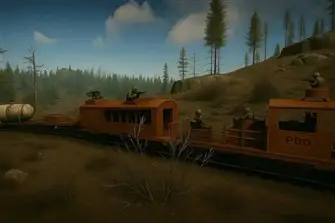
Overview #
The Train Rail Network was introduced with the Above-ground Train Update in May 2022. It provides one of the most fuel-efficient and structured methods of traveling long distances across large Rust maps.
The system includes:
- Above-ground rail lines
- Train Tunnel Network
- Transition Track Tubes linking both systems
Trains are free to use once found and require only Low Grade Fuel to operate.
General Info #
- Requires map size 4250 or greater on vanilla
- Trains spawn randomly along tracks
- Cannot be crafted or purchased
- Operate using Low Grade Fuel
- Must have a locomotive to move cargo cars
Train tracks appear as dual parallel lines. Cargo cars spawn on the outermost track.
Locomotive Types #
Large Locomotive #
- 2000 HP
- Highest pulling capacity
- Best for long hauls
- Higher fuel consumption
Covered Workcart #
- 1000 HP
- Limited pulling capacity
- Partially enclosed
Uncovered Workcart #
- 1000 HP
- Limited pulling capacity
- Open seating
Underground Workcart #
- 1000 HP
- Spawns only underground
- No underground cargo cars
Pulling more cars reduces speed, especially with smaller engines.
Cargo and Wagon Types #
Sulfur Ore Car #
- 750 HP
- Contains sulfur ore
Metal Ore Car #
- 750 HP
- Contains metal ore
Charcoal Car #
- 750 HP
- Contains charcoal
Low Grade Fuel Car #
- 750 HP
- Contains visible fuel reserves
Loot Car #
- 750 HP
- Contains loot crates
Lucky Caboose Casino #
- 750 HP
- Contains slot machines and table games
Coupling and Uncoupling #
To uncouple:
- Approach the junction
- Look at the connector
- Press interact to separate
Couple slowly to reduce collision damage.
The Large Locomotive handles multiple cars efficiently. Smaller engines struggle with heavy loads.
Fuel System #
- Maximum stack: 500 Low Grade Fuel
- Fuel is inserted into engine types only
Fuel tank locations:
- Small engines: behind cockpit, labeled FP-6
- Large locomotive: large side cylinders between wheel wells
Remove fuel to force an immediate stop.
Controls #
Forward:
- Press W once for low speed
- Twice for medium
- Three times for high
Reverse:
- Press S once for low reverse
- Twice for medium
- Three times for high
Steering at track splits:
- Hold A for left
- Hold D for right
Other controls:
- F for headlights
- Left click for horn
- Space to eject
Trains automatically slow to a stop if all occupants dismount.
Underground Rail Network #
Accessible via white circular train icons on the map.
For station-by-station underground gameplay details, see Train Tunnel Network.
Features:
- Tunnel entrances at monuments and standalone locations
- Maintenance rooms containing Underground Workcarts
- Dark enclosed environment
- Separate from surface network prior to transition tubes
Transition Track Tubes #
Large tunnel systems linking above and below networks:
- 150 to 200 meters long
- Large no-build radius
- Marked with special map icon
Most vehicle types can pass through, excluding horses.
Durability and Repair #
- Large locomotive: 2000 HP
- Workcarts: 1000 HP
- Cargo cars: 750 HP
Repair requirements:
- Hammer
- Metal Fragments
Repairs available 30 seconds after last damage.
Fuel is lost if engine is destroyed.
Decay #
Default decay:
- 30 minutes idle on tracks
- 10 minutes for freshly unloaded cargo cars
Server owners can modify via convars.
Some idle trains may persist longer depending on server conditions.
Strategy and Meta #
Advantages:
- Fuel-efficient long-distance travel
- Mobile cover during firefights
- Free vehicle access
- Strong hauling capability
Risks:
- Linear movement
- Predictable track routes
- Limited maneuverability
- Loud audio signature
Large locomotives are ideal for resource hauling. Smaller engines are better for short transport runs.
The Train Rail Network provides structured, fuel-efficient transport across large Rust maps. With both above-ground and underground systems, multiple engine types, and cargo hauling capability, it serves as a powerful mobility tool when used correctly.
Events at Location #
- No location-specific events currently linked.